
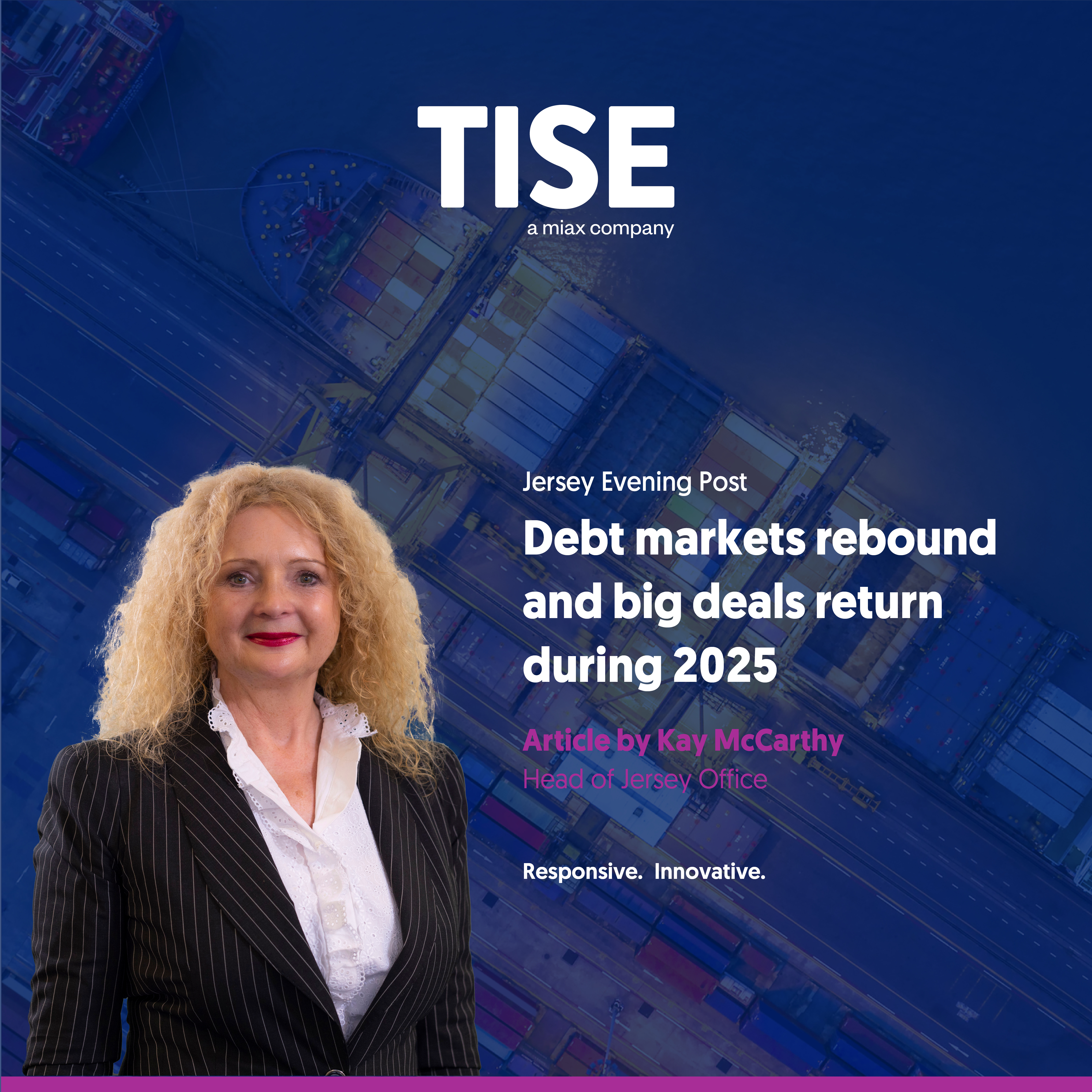
Kay McCarthy, Head of Jersey Office at The International Stock Exchange (TISE), discusses the recovery in debt capital markets and the re-emergence of the mega deal.
Debt capital markets experienced a period of transformation in 2025, driven by lower interest rates, renewed issuance activity and strong investor demand. Coming after a volatile couple of years defined by inflationary pressures, monetary tightening and geopolitical uncertainty, confidence returned as central banks eased policy and liquidity conditions improved.
Resilience in debt capital markets
Bond issuance increased significantly, particularly in the United States, where the Federal Reserve’s September rate cut triggered new issuance, refinancing and maturity extensions. Europe saw steadier activity under the European Central Bank’s stable policy stance, while governments worldwide tapped primary markets at record levels to fund recovery. High yield bonds, led by US issuers, drove much of the momentum, with refinancing emerging as the dominant theme across regions.
"High yield bonds, led by US issuers, drove much of the momentum, with refinancing emerging as the dominant theme across regions."
Macro and geopolitical uncertainty, coupled with trade tensions, prompted issuers to explore new strategies and broaden diversification across multiple sectors and currencies. Technology and biotech firms used high yield financing to support growth, and energy and utilities turned to green and transition bonds to align with sustainability goals. Banks also adjusted issuance strategies to meet evolving regulatory capital requirements.
Investor appetite shifted this year towards higher yielding, shorter duration assets, emerging market sovereigns, and floating rate bonds. ESG linked securities continued to gain traction, underscoring how sustainability considerations are now integral to capital allocation. These trends are shaping the next phase of global issuance which, despite geopolitical uncertainty, is projected to remain steady, supporting issuance volumes in 2026.
M&A Activity: Mega deals return
Global mergers and acquisitions rebounded strongly in 2025, fuelled by lower financing costs, narrowing valuation gaps and renewed confidence among corporate and private equity. Debt funded acquisitions also increased as companies favoured leverage over equity, with refinancing activity underpinning deal flow. Deal values rose despite global deal volumes declining, with a shift towards high impact transformational transactions.
"Debt funded acquisitions also increased as companies favoured leverage over equity, with refinancing activity underpinning deal flow."
Mega deals dominated headlines, particularly in North America and Asia. Union Pacific’s proposed US$71.5 billion takeover of Norfolk Southern will mark a landmark consolidation in US freight rail, while a consortium led by Silver Lake and Saudi Arabia’s Public Investment Fund have reportedly agreed to acquire Electronic Arts for US$55 billion, which would represent the largest leveraged buyout in history. Alphabet’s US$32 billion proposed purchase of Wiz highlighted the strategic importance of cybersecurity in the AI era, while Constellation Energy’s US$26.9 billion proposed acquisition of Calpine underscores momentum in energy transition.
Private equity remained resilient, with McKinsey detailing investment of almost US$3 trillion across acquisitions, recapitalisations, and take‑private deals, despite macroeconomic uncertainty. Smaller bolt‑on acquisitions and sector diversification balanced the mega‑deal surge, while dividend recapitalisations took advantage of favourable debt conditions.
Sectoral activity is reflecting long‑term structural shifts in the global economy and was concentrated in technology, energy, healthcare, and infrastructure, reflecting both investor conviction and the enduring demand for growth and resilience.
Bubble concerns
Artificial intelligence (AI) and private credit have emerged as defining themes in global markets, with mounting concerns that both may be approaching bubble territory. The AI rally has propelled valuations of leading technology firms and semiconductor companies to unprecedented levels, drawing comparisons to the dot com era and fuelling fears that investor enthusiasm may be running ahead of fundamentals.
"...these dynamics highlight the tension between innovation driven exuberance and credit driven fragility."
In parallel to this, according to the BIS, the private credit market has expanded into the trillions, with non-bank lenders assuming risks once concentrated within traditional institutions. Regulators caution that the sector’s opacity and rapid growth could magnify systemic vulnerabilities should conditions weaken.
Together, these dynamics highlight the tension between innovation driven exuberance and credit driven fragility. Yet despite the risks, neither trend is fading, they are reshaping the financial landscape in ways that market participants must adapt to rather than ignore.
The next chapter
In 2025, debt capital markets helped supply liquidity and M&A absorbed it through bold, transformative transactions. Easier access to financing allowed companies to pursue acquisitions with greater confidence, while private equity firms took advantage of favourable conditions for leveraged buyouts and recapitalisations. This interplay underscored how capital markets and corporate strategy are increasingly intertwined, with financing conditions directly shaping deal activity and execution.
"...these forces are not disappearing but rather defining the next chapter of global finance."
Looking ahead, momentum is expected to continue into 2026 with increased cross-border and sector consolidation. Global realignment is forcing companies to pursue international deals, particularly in technology and energy. Consolidation in healthcare, infrastructure, and financial services will remain strong as firms seek scale and resilience. Mega deals are likely to remain central, particularly in AI, which will continue to be a strategic acquisition target and a tool to streamline due diligence and reshape capital allocation. ESG driven transactions will continue to gain traction as corporates and investors align with sustainability goals. Private credit markets are set to expand further, offering diversification and yield opportunities.
That said, risks do remain in play. Inflation, though moderating, is still above target in many economies, geopolitical uncertainty could flare up at any time and regulatory scrutiny in the technology sector will continue. Yet, 2025 reaffirmed the resilience of global markets, confidence has returned and momentum is building. As companies and investors adapt to shifting dynamics, the opportunities ahead are substantial; these forces are not disappearing but rather defining the next chapter of global finance.
This article was originally published in the Jersey Evening Post, December 2025.

Kay McCarthy
Head of Jersey Office